


Welcome to the first edition of “Book Reports,” where I share passages from books I’ve found intriguing recently. I’ll aim to post these once per month. I’ll also include a few links to articles and podcasts that have piqued my interest.
So without further ado…
Is Prince Harry a Reliable Narrator?
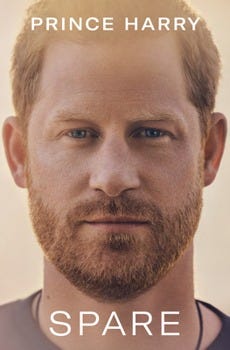
I slogged through Prince Harry’s memoir, Spare, thinking I might write a review on it, but ended up abandoning those plans. Throughout the book, I often wondered if Harry was a reliable narrator, especially when it comes to stories about his family. The issue is, the Royal Family is likely to stick to their centuries-old tactic of “never complain, never explain,” so these stories remain one-sided.
But there are exceptions to this. One instance is when Harry writes about an interview he had with “Willy” during the brief time they lived together in their 20s:
While sharing that cottage we agreed to a rare joint interview, in an airplane hangar at Shawbury, during which Willy griped endlessly about my habits. Harry’s a slob, he said. Harry snores.
I turned and gave him a look. Was he joking?
I cleaned up after myself, and I didn’t snore. Besides, our rooms were separated by thick walls, so even if I did snore there was no way he heard. The reporters were having fits of giggles about it all, but I cut in: Lies! Lies!
That only made them laugh harder. Willy too.
I laughed as well, because we often bantered like that, but when I look back on it now, I can’t help but wonder if there wasn’t something else at play. I was training to get to the front lines, the same place Willy had been training to get, but the Palace had scuttled his plans. The Spare, sure, let him run around a battlefield like a chicken with its head cut off, if that’s what he likes.”
What Harry describes sounds like…normal joking between two brothers? Was it really that bad? What would William’s recollection be?
Thankfully, there’s video of the interview.
The entire book is like this: a catalog of every slight Harry has ever received from his family, especially William. “Looking back on it now” could be the subtitle because it’s clear Harry has gone back through his memories and read nefarious intent into even the most inane interactions.
That time Clinton meddled with Russian elections

In his excellent book, “The Nineties,” Chuck Klosterman looks back at the decade as it was experienced at the time. In doing so, he reveals moments that were lost to history:
There are things forgotten by chance, and there are things forgotten on purpose.
But then there are things that aren’t really forgotten as much as they are deliberately ignored, usually because the memory has come to necessitate an elephantine level of discomfiting rationalization.
One example of this phenomenon is stunning:
America’s involvement with the 1996 Russian democratic election falls into this third category. Boris Yeltsin, the boozehound incumbent, overcame mass unpopularity to win reelection as Russian president, significantly due to assistance from clandestine United States operatives and the support of Bill Clinton.
When the news of this subversion first surfaced, it was hailed as a masterstroke of U.S. statecraft. The July 15 cover of Time magazine pulled no punches: “Yanks to the Rescue: The Secret Story of How American Advisers Helped Yeltsin Win.”
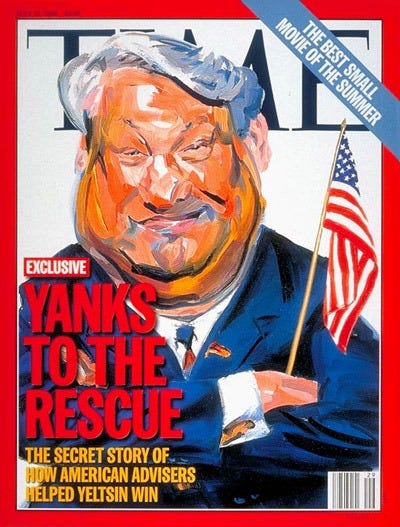
Since the story came out in 1996, there is an online version of the story of Boris Yeltsin’s stunning comeback to win the Russian election:
The outcome was by no means inevitable. Last winter Yeltsin’s approval ratings were in the single digits. There are many reasons for his change in fortune, but a crucial one has remained a secret. For four months, a group of American political consultants clandestinely participated in guiding Yeltsin’s campaign. Here is the inside story of how these advisers helped Yeltsin achieve the victory that will keep reform in Russia alive.
What Klosterman notes is that:
We do know that Yeltsin was way behind in 1995 and somehow won easily in ‘96, and that most historians classify the entire rease as either mildly or heavily corrupt. The expressed U.S. position on the meddling was that America had a stake in the outcome. Yeltsin was the best hope for expansion of democracy, and bloodlessly shaping international policy is the definition of what diplomacy is. It wasn’t a conspiracy. It was a plan, and the plan worked. It’s just not a plan we prefer to remember.
Hammer and Sickle and Women’s Equality
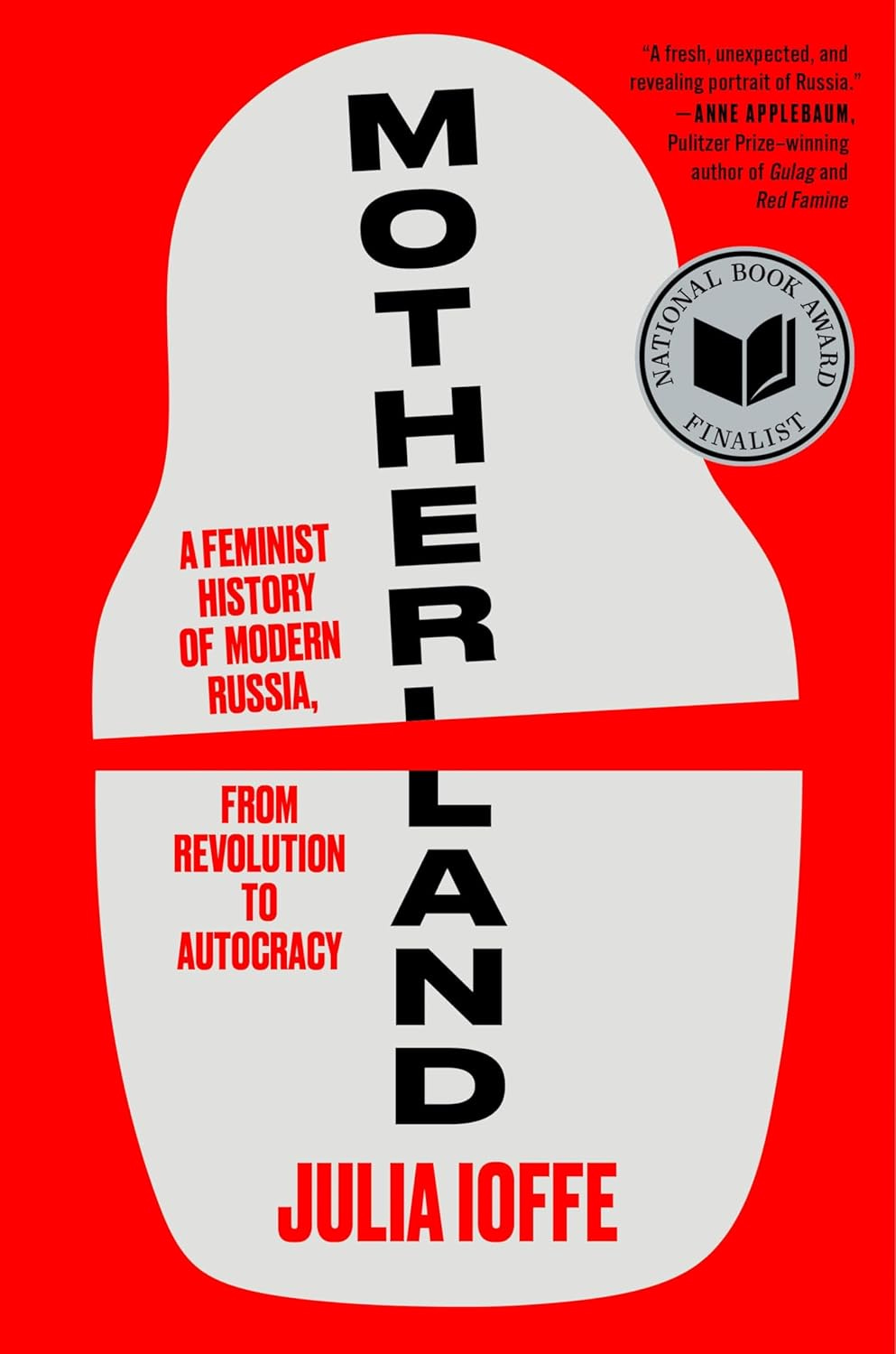
Speaking of Russia, I recently began reading Julia Ioffe’s “Motherland: A Feminist History of Modern Russian from Revolution to Autocracy.” The National Book Award finalist traces the history of Russia in the 20th century through the stories of notable women.
Moscow-born Ioffe describes her personal lineage this way:
My little sister, an oncologist, is the fourth generation of women in our family to practice medicine. She follows our mother (a pathologist), our mother’s mother (a cardiologist), and our mother’s mother’s mother (a pediatrician). In fact, two of our great-grandmothers were doctors. Another was a PhD in chemistry who, in the 1930s, ran her own lab and published scientific papers at a time when her peers in the West still needed their husbands’ permission to do much of anything. (Our other grandmother, for what it’s worth, was a chemical engineer who oversaw the lab at a water filtration plant that supplied the Kremlin’s drinking water.)
But Ioffe points out this is not so remarkable in the context of the Soviet Union:
But, measured against the history of their own country, the Soviet Union, the women from whom I descend were perfectly average people. They were ordinary women who happened to be the subjects—and products—of one of the most radical social experiments in history: the attempt to emancipate women and build a new Soviet person. This book is, in part, an effort to explain the extraordinary circumstances that transtormed the lives of my rather ordinary foremothers.
The egalitarian society produced some remarkable rights and benefits decades before the United States.
By 1917, Soviet women had the (increasingly irrelevant) right to vote, years before their Western peers. They had the right to no-fault divorce and child support, paid maternity leave, and free higher education, including in the sciences, by 1918. By 1920, they had the right to abortion, provided by the state for free.
Women also joined the ranks of the military:
The experiment in erasing the legal, educational, and social differences between men and women was so successful that the first post-Revolutionary generation of Soviet women took up arms to fight the Nazis en masse. When Hitler’s army invaded the USSR in the summer of 1941, tens of thousands of young women, most of them teenage girls, swarmed recruitment posts all over the country. Eventually, nearly a million of them would serve in the Red Army, as machine gunners and medics, as sappers and artillery officers, as snipers and fighter pilots in all-female squadrons. This was without parallel among any of the countries fighting in World War II.
I’m looking forward to reading the rest of the book to see if women enjoyed equality in the Soviet bread lines and gulags.
Articles I’m Reading
Politico does a deep dive into the once-promising University of Austin and how it seemed to turn on the very values it claimed to uphold almost immediately.
Jeff Maurer, who used to write for Jon Oliver and has since repented, writes an excellent Substack and recently asked after the Grammys, “Will Celebrities Ever Realize They’re Not Helping?”
Historian H.W. Brands writes about why parts of America like to hate on Texas and how Texans view critiques of their state as merely envy (accurate).
Michelle Goldberg of the New York Times discusses the absurd fallout for Bowen Yang and his podcast co-host after they expressed skepticism about Rep. Jasmine Crockett’s bid for U.S. Senate.
Podcasts I’m listening to
Andrew Sullivan recently interviewed conservative writer and Lubbock native Kevin Williamson about the dangers of populism. Come for the anecdote about George W. Bush joking about Lubbock High being terrible at football, stay for the discussion of Lubbock’s demographics of rednecks, farmers and college professors.

Dennis Sanders is a welcome voice of pastoral care and wisdom on Substack and I appreciate his excellent podcast (which I appeared on last year). Dennis lives in the Minneapolis area and has had several episodes recently about how he’s processing what’s happening in his own backyard.
Despite not being a huge sports fan, I’m a big fan of Ethan Strauss and his excellent podcast. He recently had Chuck Klosterman on to talk about his latest book on football. The episode is so good that I, someone who rarely watches football, found the discussion fascinating.


Happy Super Bowl weekend!
🎂 Ryan’s Boring Book Club Turns Two!

It’s been another great year for Ryan’s Boring Book Club. I expanded my writing into outlets like “The Coddling of the American Mind Movie” Substack. I got to interview two dear friends, Zach Lambert and Karen Keen, who published books this year. I also interviewed former
📚 My Top 10 Books of 2025

Tis’ the season for year-end lists and since everyone from Obama to Dua Lipa to Oprah are posting their top 10 lists, I thought I would join my peers and share some of my favorite reads from the past year. This year’s list includes books from personal friends, books about SNL, Vanity Fair, the 2024 presidential candidates, Meta and more. All but two wer…